Download our free eBook about the art of Korea! It contains all the article
above in the handy eBook format for viewing on your PDA. Click the link below to
download it now. After you download it, move it to your PDA and it will be added
to your Microsoft Reader Library.

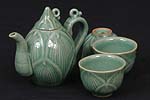
"The simple
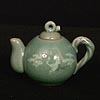
elegance and subdued beauty of celadon tea ware adds quiet peace to a relaxing
moment with a cup of your favorite tea."
Tea was fist discovered about 2700BC
and was first cultivated around 350AD in China. The first recorded tea ceremony
was held in China about 800AD but in Korea the first offering of tea to an
ancestral god was believed to have been performed in the year 661.
Since then tea culture in Korea developed initially as
a way to make Buddhist offerings during ancestral worship, but eventually was
embraced by the Confucian scholars, and the Taoists as well. The Buddhists felt
the stimulating effect of the tea helped to bring them closer to the gods or
ancestors. Later, the Confucian scholars during the Chosun Dynasty
embraced the tea ceremony both as a way to make offerings to the ancestors, but
also as a formal rite to be used during meditation and to help them relax and
focus the mind. In fact, the use of the tea ceremony was so prevalent among the
literati or scholars of the time (who were frequently also government officials)
that it became a common practice during meetings of government officials
and became almost a part of the job. We can see the lingering effect of that
today in modern Korea in which most business meetings are accompanied by a
mandatory cup of tea or coffee. The Taoists also embraced tea drinking and the
tea ceremony as a way of helping them find the "way" - the way to spiritual
enlightenment - and to purify the mind. Today it is still used as a way to help
one meditate, purify the mind, and reach spiritual enlightenment.
Korean green tea can be roughly classified
into three categories based primarily on the time the tea leaves were picked.
The fist category is called U-jeon (우전) and consists of the first tea
leaf buds that appear around April 21. Of course the time varies slightly
each year, but these first buds of the leaves are picked before they become too
large and are used to make tea with the most delicate flavor and fragrance. The
second classification is called Se-jak (세작) and are the slightly larger
leaves that appear about 14 days after the first harvest. The third picking,
Jung-jak (중작) are picked about 14 days after the second and all consecutive
pickings for the rest of the year are classified as Dae-jak (대작). These
last pickings are what is used to make most of green tea supplied in tea bags.
It consists of pieces of larger tea leaves and has a stronger, somewhat harsher
flavor than the first three pickings. Read more...